

A Song of Wholeness
I heard my daughter in another room, angrily banging on her keyboard. She was practicing for her recital the next day and growing frustrated when her fingers didn’t properly dance across the keys to “Rockin’ Around the Christmas Tree.”
The cacophony ceased, and I walked in to find her crying into her hands. I took her in my arms and asked, “What’s wrong, baby girl?”
“I can’t get it right,” she sobbed. “I need to play it perfectly!”
I wonder where she gets that from, I thought. I remembered the same perfectionist anxiety I carried as a little girl—singing a solo at church, taking a test, or playing in my own piano recitals. I held her tenderly in my arms, empathizing with the familiar weight of perfectionism.
I’ve learned and grown a lot since I was a little girl preparing for piano recitals. And because my daughter is so much like me (including my weaknesses), I realized I could offer her truths and tools I didn’t grasp until much later in life.
After a long hug, I asked her, “What’s the worst thing that could happen if you didn’t play it perfectly?”
She twisted her toe against the floor. “Well,” she whispered. “What if everyone listening doesn’t like me?”
My heart broke at her honest confession. I remembered how deeply the fear of letting others down shaped many of my own choices over the years.
"Mommy, Daddy, Didi, and Grand will all be there, right?” I asked. She nodded. “And you know that there’s nothing you could do to make us love you any more or any less. It doesn’t matter if you play your piece perfectly or trip and fall into the piano.” She giggled and sniffed away her tears. “We love you no matter what. That means you’re free to do your best and make mistakes.”
She nodded along, like she was beginning to understand.
“Even better than our love for you is God’s love for you,” I continued. “Jesus was perfect because he knew that you couldn’t be. He knew you’d mess up your piano song, disobey mommy and daddy, and be unkind to your siblings. That’s why he became human—to live the perfect life you and I couldn’t live. Since we’ve put our faith in him, our relationship with God is not based on what we do, but on what Jesus has already done for us.”
She wiped away her tears and offered a small smile.
“Does that make you feel better?” I asked
“A little,” she admitted. “But sometimes I forget that.”
“Oh, me too,” I said with a laugh. “That’s why we need to take captive the lying thoughts that tell us we have to be perfect and give those thoughts to Christ.” (2 Corinthians 10:5)
“How do we do that?” she asked eagerly.
Together, we acted it out—pulling the yucky, untrue thoughts from our heads and tossing them to Jesus. We giggled and hugged, and I felt her sigh as her body relaxed in my arms.
“I feel better,” she said. “I think I’ll keep practicing my song.”
She turned back to her keyboard, and I sat nearby listening as she played—still imperfect, but lighter, smiling with her usual joy.
If only I’d grasped those truths at her age, I thought. But I’m grateful I get to share them with her now.
The next night, she played beautifully (albeit imperfectly) at her piano recital. Before she walked on stage, I mouthed a quick “I love you,” and she mimed throwing an anxious thought to the Lord. I smiled, and tears came to my eyes.
What I shared with her that night has been a lifelong learning process for me—one I explore in my book, Perfected. As I watched her play, I praised God for his work in both of our lives. Seeing her grow in faith through the ways the Lord has shaped me is worth more than any book review or sales report.
In the months since my book was released, I’ve learned that the true impact of our words isn’t measured by Amazon rankings or social media shares, but by changed hearts. Each time a woman shares how her story intersected with mine, I’m humbled that God allows me to play even a small part in helping others trade shame and striving for wholeness in Christ.
There is no greater joy than sharing that message of wholeness in Christ with my daughter—watching her grow up knowing she doesn’t have to be flawless to be fully loved. That she is not made whole by getting every note right, but by being held by her family and, even more, by her Heavenly Father.
The message I get to share with my children, through my writing, and by speaking to women is that Christ offers us a wholeness far deeper than white-knuckled perfectionism. Scripture tells us “he has perfected for all time those who are being sanctified.” (Hebrews 10:14). His wholeness is more than a 4.0 GPA, an impeccable resumé, a tidy home, or a flawless appearance. It isn’t an external ideal to achieve, but an internal peace to receive.
Christ sees where we are lacking. He knows every imperfection we try to hide behind shame and striving—our sin, our doubts, our weaknesses. And instead of adding more weight to our shoulders, he bore it himself, making us complete in him.
As my daughter played at her piano recital, joyfully yet imperfectly, I saw a glimpse of the life I pray she’ll carry with her— one free from the endless cycle of shame and striving that held me for so many years.
Not because she is perfect, but because she is already perfected in Christ.
This post is part of a blog hop with Exhale—an online community of women pursuing creativity alongside motherhood, led by the writing team behind Coffee + Crumbs. Click here to view the next post in the series "Whole."
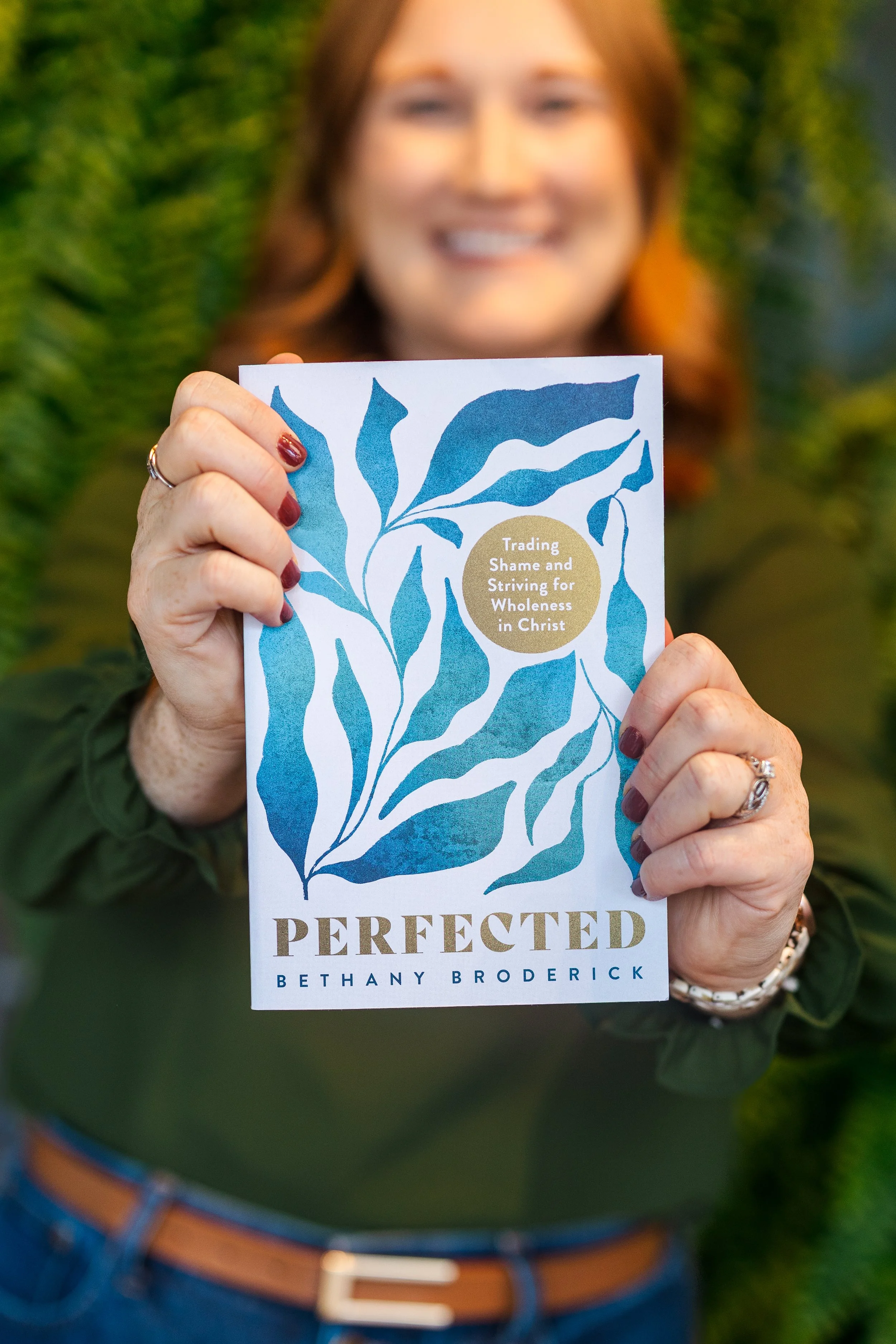
Longing for wholeness instead of striving for perfection?
If this story resonated with you, my book Perfected explores these same themes of perfectionism, shame, and the freedom Christ offers us to be whole. Through Scripture, personal stories, and practical reflection, Perfected invites you to release your shame and striving and to rest in what Jesus has already done.